Shifting Down
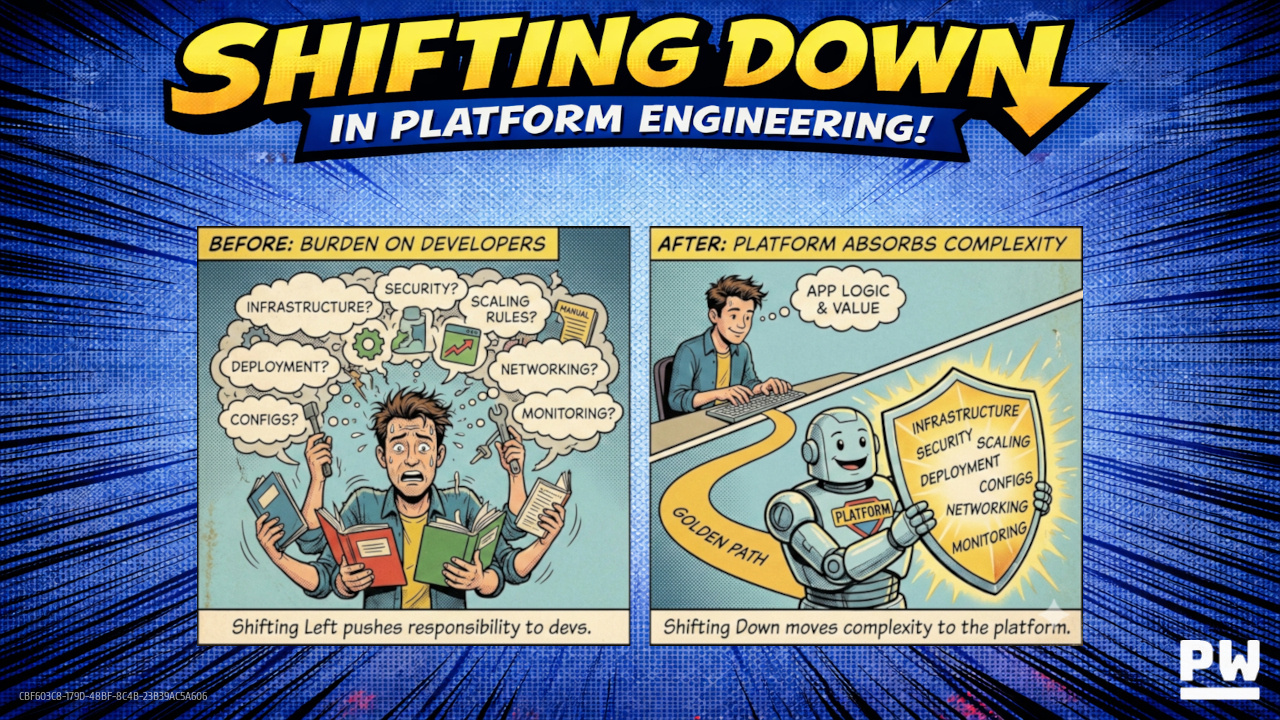
Platform engineering is often described in terms of enabling teams, reducing friction, and accelerating delivery. Behind those outcomes is a deceptively simple idea: shifting down. If "shift left" pushed quality and security earlier in the lifecycle, shifting down pushes something else entirely. It moves complexity, responsibility, and risk into the platform layer, where it can be handled once and reused everywhere. The result is not less ownership for developers, but less unnecessary burden.
In platform engineering, shifting down means embedding operational knowledge and architectural decisions directly into the platform. Instead of asking every application team to understand infrastructure internals, deployment mechanics, and reliability patterns, the platform takes on that responsibility. Developers interact with higher-level capabilities while the platform absorbs the details. Teams still build, deploy, and operate services, but they do so through well-defined interfaces rather than raw tools and fragile configurations.
Many organizations rely on documentation, standards, and reviews to spread best practices, but these approaches do not scale well. They depend on humans remembering what to do, often under time pressure. Shifting down replaces documentation-heavy guidance with built-in capability. Instead of telling teams how to configure autoscaling, observability, or security, the platform provides those features by default. The best platform decisions are the ones developers never have to consciously make.
Operational concerns are often the first things to shift down. As platforms mature, they standardize deployment strategies, rollout behavior, scaling rules, and failure handling. Rather than each team solving these problems independently, the platform encodes proven patterns and applies them consistently. Operations become a shared, productized concern instead of a repeated exercise in trial and error, reducing variability across services and lowering the chance of subtle misconfigurations causing outages.
Infrastructure is another natural target for shifting down. Early on, teams may write their own infrastructure definitions, choose resource sizes, and manage networking and secrets themselves. As a platform evolves, those details disappear behind higher-level abstractions. Teams request capabilities instead of infrastructure, and the platform provisions, secures, and connects resources automatically. Infrastructure stops feeling like a prerequisite and starts behaving like a service.
Security benefits significantly from being shifted down. When authentication, encryption, access control, and scanning are enforced at the platform layer, security becomes consistent and unavoidable. Instead of relying on teams to remember every requirement, the platform bakes security in from the start. Safe behavior becomes the default, not the exception, which is especially valuable in regulated environments where uniformity and auditability matter as much as speed.
Golden paths and paved roads are practical expressions of shifting down. They capture organizational best practices and turn them into easy-to-follow workflows. Teams adopt them not because they are mandated, but because they remove friction. The supported path is also the fastest and safest one, aligning incentives with outcomes and making the platform the natural choice.
Shifting down is often confused with shifting left, but they solve different problems:
Shifting Left: Asks teams to engage earlier with quality, testing, and security.
Shifting Down: Reduces how often teams need to engage with those concerns at all.
The platform becomes the expert, applying lessons learned across the organization automatically. Both ideas are complementary, but shifting down is what allows scale without burnout.
When done well, shifting down lowers cognitive load for developers, speeds up onboarding, and reduces operational risk. It creates consistency without constant coordination and allows teams to focus on product value instead of infrastructure mechanics. Developers spend less time asking whether they configured something correctly and more time delivering meaningful improvements. That confidence becomes a real competitive advantage.
Shifting down is not free. It requires strong opinions, deep expertise, and ongoing investment. Poor abstractions can feel restrictive or leaky, while good ones feel invisible. The goal is not to hide reality, but to encapsulate it responsibly and evolve it based on real usage. Platform engineering is product engineering, just with a different audience.
Ultimately, platform engineering succeeds not by adding more tools, but by removing decisions. Shifting down turns hard-won operational experience into reusable, automated capabilities and lets organizations scale without scaling complexity. In the best platforms, the most important work is the work nobody notices, and that is exactly how you know it is working.
Check back for another post about shifting down. Another one is in the works.


