The Claw AI Agent Family
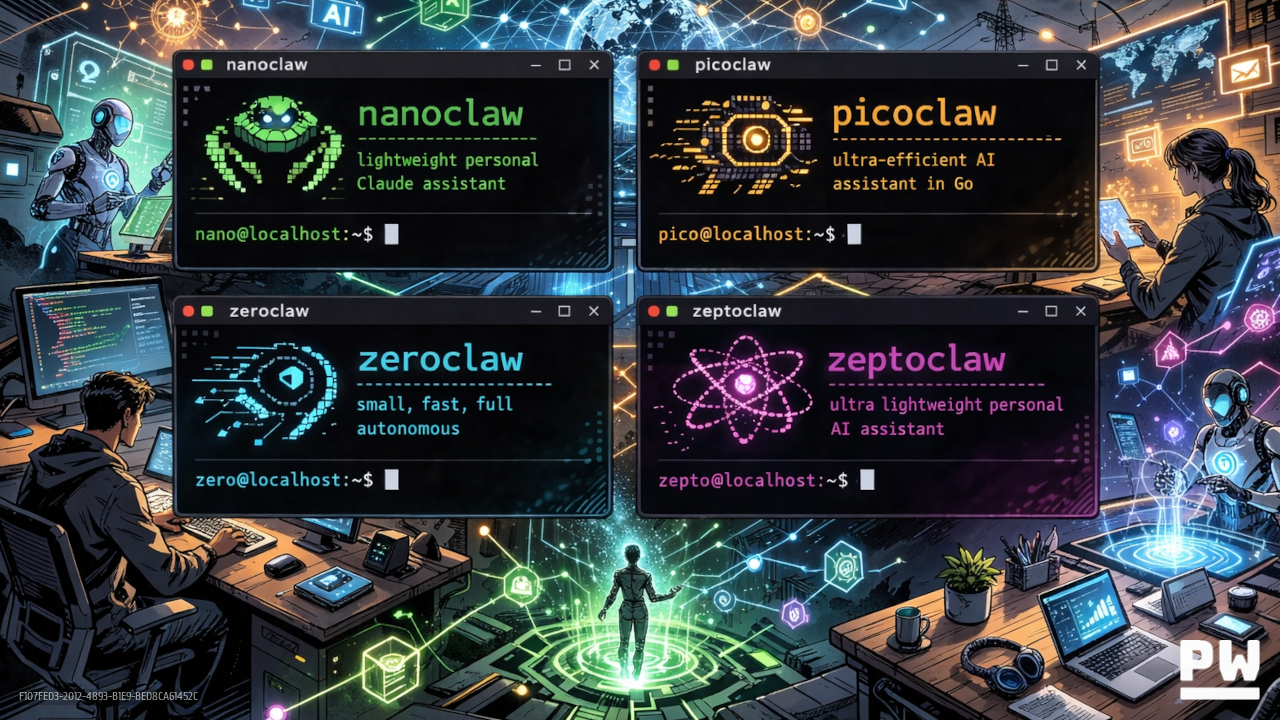
OpenClaw has inspired a whole new class of self-hosted, efficient, low resource, personal AI agents that are just starting to gain traction. The rapid rise of these local AI agents has created a confusing landscape. While many tools appear similar in demos, reading files or executing commands, they embody radically different philosophies about autonomy, persistence, and responsibility. The real cost of choosing the wrong system is rarely visible on day one; it manifests later as debugging pain, security exposure, or a total loss of trust when an agent behaves unpredictably. You are not just choosing a feature set. You are choosing how much responsibility the AI will hold over your data and infrastructure.
| Question | Why it matters |
|---|---|
| How long does the AI exist? | Determines risk and predictability |
| Does it remember? | Affects drift and reliability |
| Does it plan? | Determines automation capability |
| Can it repeat tasks? | Determines production suitability |
From Workers to Functions
To understand these tools, you must view them on an autonomy spectrum. On one end, NanoClaw acts as an autonomous worker, possessing a continuous lifespan and high agency. Moving toward the center, PicoClaw functions as a persistent assistant, while ZeroClaw operates as a structured task runner. At the far end, ZeptoClaw is closer to a stateless function call. Generally, the more persistent a system is, the more flexible it becomes, but it also becomes harder to predict. Stateless systems like ZeptoClaw trade that creative spark for absolute reliability and repeatability.
| Agent | Role |
|---|---|
| NanoClaw | Autonomous worker |
| PicoClaw | Personal assistant |
| ZeroClaw | Task runner |
| ZeptoClaw | Stateless function |
Lifespan and Risk
The fundamental difference between these frameworks lies in how long they live. NanoClaw is continuous; it exists indefinitely, accumulating context and making independent decisions, which places it at the highest risk level for unpredictability. PicoClaw exists for the duration of a session, making it a moderate-risk assistant. ZeroClaw and ZeptoClaw are significantly more constrained; ZeroClaw lives only for the duration of a specific task, while ZeptoClaw lives only for a single action. This makes ZeptoClaw the choice for minimal-risk, deterministic transformations, while NanoClaw is reserved for high-stakes automation.
| Property | NanoClaw | PicoClaw | ZeroClaw | ZeptoClaw |
|---|---|---|---|---|
| Lifespan | Continuous | Session | Per task | Per action |
| Autonomy | High | Medium | Low | None |
| Determinism | Low | Low | High | Absolute |
| Best for | Automation | Assistance | Pipelines | Transformations |
| Risk level | Highest | Moderate | Low | Minimal |
Conversations vs Pipelines
Each system solves a different category of problem, and confusion often happens when users attempt automation with interactive tools. If your primary goal is a fluid, back-and-forth dialogue, PicoClaw is the standout performer, offering an excellent conversational experience. However, if you need an agent to plan complex, multi-step projects, NanoClaw's high autonomy makes it superior. For the industrial side of AI, batch processing and massive data validation, ZeptoClaw and ZeroClaw are the workhorses. ZeptoClaw excels at quick transformations but lacks conversational ability, whereas ZeroClaw is the ideal bridge for long, automated workflows that require a limited degree of planning.
| Risk | NanoClaw | PicoClaw | ZeroClaw | ZeptoClaw |
|---|---|---|---|---|
| Prompt injection persistence | Yes | Yes | No | No |
| File damage | Contained/large | Local | Single run | None |
| Credential exposure | Medium | High | Low | Minimal |
| Long-term compromise | Possible | Possible | Impossible | Impossible |
Isolation and Injection
Security risks in the claw family are directly tied to persistence. Because NanoClaw and PicoClaw are persistent and accumulate context, they are vulnerable to long-term prompt injection. A malicious instruction hidden in a file today could compromise these agents weeks from now. ZeroClaw and ZeptoClaw are virtually immune to this long-term compromise because they start with a clean slate for every task. While NanoClaw offers a contained environment for potential file damage, its persistent nature means credential exposure remains a medium-level concern, whereas ZeptoClaw's statelessness minimizes almost all traditional attack vectors.
| Factor | NanoClaw | PicoClaw | ZeroClaw | ZeptoClaw |
|---|---|---|---|---|
| Repeatable outputs | Weak | Weak | Strong | Perfect |
| Debugging | Complex | Manual | Replayable | Trivial |
| Auditability | Limited | Limited | Good | Excellent |
| Prompt injection persistence | Yes | Yes | No | No |
| File damage | Contained/large | Local | Single run | None |
| Credential exposure | Medium | High | Low | Minimal |
| Long-term compromise | Possible | Possible | Impossible | Impossible |
The Quest for Perfect Outputs
In a production environment, being able to repeat a result is often more valuable than being clever. ZeptoClaw offers perfect repeatability; because it is stateless and deterministic, it produces the exact same output for the same input every time. ZeroClaw also scores high here, making its outputs easy to audit and replay. Conversely, NanoClaw and PicoClaw are drifty. Because they learn and adapt over time, debugging them is complex. The agent's internal state is constantly changing, making it difficult to replicate a specific failure that occurred previously.
| Factor | NanoClaw | PicoClaw | ZeroClaw | ZeptoClaw |
|---|---|---|---|---|
| Repeatable outputs | Weak | Weak | Strong | Perfect |
| Debugging | Complex | Manual | Replayable | Trivial |
| Auditability | Limited | Limited | Good | Excellent |
Setup vs. Maintenance
There is a trade-off between the effort required to start and the effort required to keep going. NanoClaw requires a high initial setup cost and ongoing monitoring to ensure its autonomous decisions do not veer off-course. PicoClaw is the easiest to get running quickly, but it requires high manual maintenance as a human must stay in the loop to guide its sessions. ZeptoClaw represents the set it and forget it model; setup is nearly non-existent, and because it has no memory to manage, maintenance is essentially zero.
| Effort | NanoClaw | PicoClaw | ZeroClaw | ZeptoClaw |
|---|---|---|---|---|
| Setup | High | Low | Medium | Very low |
| Maintenance | Low | High | Low | None |
| Monitoring | Needed | Human | Logs | Metrics |
Drift vs Rigidity
When these systems fail, they do so in characteristic ways based on their autonomy and persistence. NanoClaw is prone to behavioral drift. Its continuous memory can accumulate irrelevant or conflicting information, causing it to partially execute tasks or make unpredictable decisions. Recovery often requires manual intervention or a reset of its internal state. PicoClaw exhibits moderate drift. Since it exists for a session, its decisions are more predictable than NanoClaw but still can degrade over longer interactions. Partial execution is possible, and human supervision is recommended. ZeroClaw is mostly deterministic. Failures are usually procedural: a task may fail cleanly due to invalid input or environmental conditions, but the errors are reproducible and easy to debug. Recovery typically involves rerunning the task. ZeptoClaw is the most rigid. It either succeeds completely or fails immediately with no partial execution. Its stateless nature ensures perfect repeatability, making error handling straightforward.
| Failure Characteristic | NanoClaw | PicoClaw | ZeroClaw | ZeptoClaw |
|---|---|---|---|---|
| Drift over time | High | Medium | None | None |
| Partial execution | Possible | Possible | Controlled failure | Impossible |
| Reproducible errors | Low | Low | High | Perfect |
| Recovery strategy | Reset memory | Restart session | Rerun task | Retry action |
Choosing the Smallest Abstraction
The golden rule of the claw family is to choose the smallest amount of AI autonomy that solves your problem. If you are just exploring what is possible, start with PicoClaw. If you need to guarantee a specific data transformation for a business process, use ZeptoClaw. Only move up to NanoClaw when you truly need an agent that can decide and act without a human holding its hand. Most users find that as their needs mature, they move away from high-autonomy explorers and toward low-autonomy, predictable operators.
| Goal | Recommended |
|---|---|
| Explore | PicoClaw |
| Automate reliably | ZeroClaw |
| Guarantee output | ZeptoClaw |
| Autonomous decisions | NanoClaw |
Maturity and Adoption
The claw family represents a new generation of autonomous and semi-autonomous AI agents, and their relative maturity reflects both technical development and community adoption. NanoClaw is the most ambitious but also the least mature in practical deployments. Its high autonomy and persistent memory make it a powerful tool for complex automation, but early adopters report challenges around stability, reproducibility, and safe integration into existing workflows. Only a handful of platform teams are running NanoClaw in production at scale, so real-world lessons are still emerging. PicoClaw has gained traction quickly among individual developers and AI enthusiasts. Its session-based persistence strikes a balance between flexibility and safety, making it ideal for exploratory tasks, coding assistance, or conversational workflows. While it is technically simpler than NanoClaw, it benefits from an active community experimenting with use cases, plug-ins, and integrations. ZeroClaw is seeing adoption primarily in small to medium enterprise automation contexts. Its deterministic behavior and task-limited lifespan make it reliable for pipelines and repeated workflows, even if it lacks the creativity or conversational depth of PicoClaw or NanoClaw. Early adoption suggests that ZeroClaw is stable enough for production in structured environments, but it still lacks broad open-source ecosystem support. ZeptoClaw is highly specialized and extremely reliable, but it is still very new. Its stateless, single-action design makes it the easiest to integrate into batch or high-volume processes with deterministic needs. Adoption so far is mostly experimental or limited to proof-of-concept pipelines, though organizations focused on data validation or repetitive transformations are beginning to explore its potential. Across the claw family, the trend is clear: higher autonomy correlates with lower maturity and slower adoption, while stateless, deterministic agents are easier to deploy reliably but still have a narrow set of applications. Teams considering these agents must weigh not only technical capabilities but also the state of the ecosystem, documentation, and early user feedback.
| Agent | Technical maturity | Community adoption | Typical use cases |
|---|---|---|---|
| NanoClaw | Low/experimental | Limited | Complex automation, autonomous workflows |
| PicoClaw | Medium | Growing | Interactive tasks, coding assistance, exploration |
| ZeroClaw | Medium/High | Moderate | Reproducible pipelines, workflow automation |
| ZeptoClaw | Low | Experimental | High-volume transformations, deterministic actions |
Minimum Compute Resources
As their name imply, each of these agent are supposed to be lightweight. All four claw agents are designed to run on minimal hardware. PicoClaw, in particular, is ultra-lightweight, using under 10 MB of memory and starting in under a second. NanoClaw is slightly heavier due to its higher autonomy but still fits low-resource environments for simple tasks. ZeroClaw and ZeptoClaw are lightweight, stateless, and ideal for task-limited execution, making them suitable for CPU-only systems with very small memory requirements.
| Resource | NanoClaw | PicoClaw | ZeroClaw | ZeptoClaw |
|---|---|---|---|---|
| CPU | 1 core | 1 core | 1 core | 1 core |
| RAM | 50–100 MB | <10 MB | 10–20 MB | 5–10 MB |
| GPU | Optional | Not needed | Not needed | Not needed |
| Notes | Lightweight tasks | Ultra-lightweight personal assistant | Task-limited, minimal overhead | Stateless, single-action, minimal overhead |
All four agents are designed to run comfortably even on low-end hardware. PicoClaw shines in extremely constrained environments (like small embedded devices or microservers), while ZeptoClaw is similarly minimal. ZeroClaw and NanoClaw require slightly more memory for multi-step or autonomous reasoning but remain very low-resource compared to conventional AI systems.
What Really Matters
When choosing among these agents, focus on autonomy, persistence, reliability, and risk. Higher autonomy, like NanoClaw, increases flexibility but also unpredictability, while low-autonomy agents such as ZeptoClaw are fully predictable. Persistent agents remember context, which aids reasoning but introduces drift and potential security exposure; stateless agents minimize risk and ensure repeatable outputs. Production workflows demand reliability, so ZeroClaw or ZeptoClaw are safer for critical tasks. Ultimately, the guiding principle is to select the simplest agent that reliably solves your problem while matching your team’s capacity to supervise and maintain it.
I have a few small projects and experiments lined up for a few of these. I do have some spare hardware where these will run comfortably. If I stand up anything useful, I will drop a guide here.


